Use this packing list as a baseline, then adjust for your weather, distance, and species. Forgetting a single item rarely ruins a day hunt close to the truck, but it can end a backcountry trip early or put you in a dangerous spot. Build your kit once, keep it packed, and run through the list before every trip.
Day hunt essentials
These are the non-negotiable items for any hunt, even a morning sit in a treestand two hundred yards from the road. If you leave camp or the truck, every one of these should be on your person or in your pack.
License, tags, and ID
Carry your hunting license, any required tags or permits, and a valid photo ID. In most states you must have physical proof of your license on you while hunting, though many now accept a digital copy on your phone.1 Print a backup anyway. Phones die, screens crack, and cell service is unreliable in the field. Keep paper copies in a waterproof bag or laminated sleeve. If you are hunting out of state, bring your hunter education card as well since some states require it at check stations.
Water and calories
Dehydration sets in fast, especially during early-season hunts when temperatures are still warm. Carry at least one liter of water for a half-day sit and two liters or more if you plan to cover ground. A hydration bladder works well for spot-and-stalk hunts where you need hands-free access. For calories, pack dense, quiet food. Jerky, nuts, peanut butter packets, and energy bars all travel well and do not rustle in a treestand. Avoid anything with strong odors that could alert game downwind of your position.
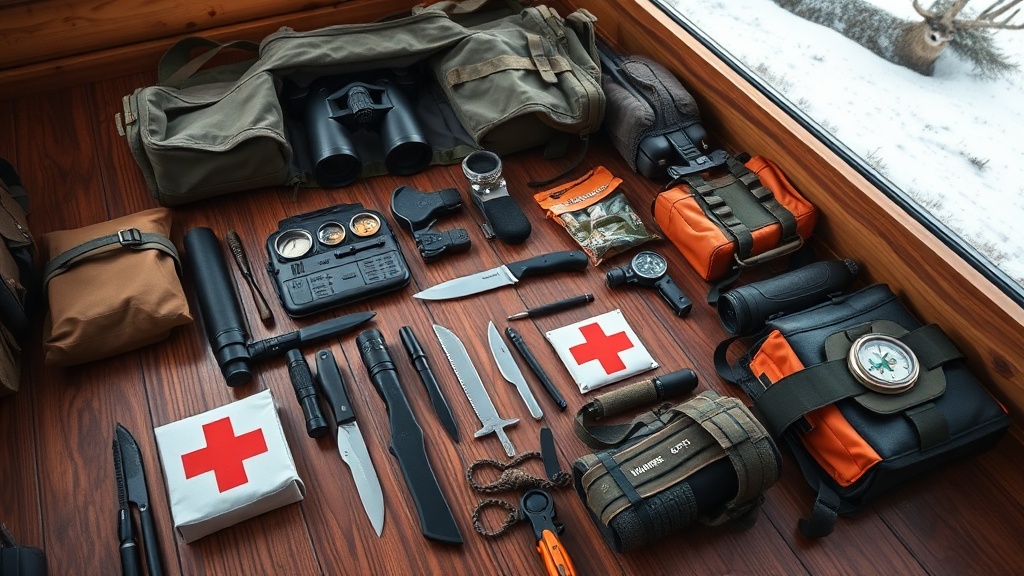
Knife and basic field care kit
A fixed-blade knife with a 3- to 4-inch drop point is the most versatile option for field dressing. Folding knives work too, but blood and fat can gum up the pivot under field conditions. Alongside the knife, carry a few gallon-size zip bags, a couple of rubber gloves, and 10 feet of paracord. The bags keep the heart and liver clean if you save organs. The gloves keep your hands sanitary and make the drive home far more pleasant. Paracord is useful for dragging, hanging, and propping open a body cavity to cool. If you are hunting in warm weather, add a compact bone saw and game bags to protect meat from flies.
Navigation and light
At minimum, carry a headlamp with fresh batteries and a way to navigate back to camp or the truck in the dark. A GPS unit or phone with a downloaded offline map covers navigation. OnX, HuntStand, and Gaia GPS all allow you to cache maps over cell data before you leave home.2 Even on familiar ground, a wrong turn in timber at dusk can burn an hour. Mark your truck, stand, and any key waypoints before you start hunting. Carry a small backup light as well, either a second headlamp or a pocket flashlight. Headlamps fail at the worst times.
First aid
A basic first aid kit for a day hunt does not need to be large. Focus on items you would actually use: adhesive bandages, gauze pads, medical tape, antiseptic wipes, ibuprofen, and a triangular bandage or elastic wrap for sprains. Add a tourniquet if you are hunting alone or in remote terrain. Arterial cuts from a knife slip or a fall onto a broadhead are rare but serious. A CAT or SOF-T tourniquet weighs a few ounces and could save your life or a partner’s life before help arrives.3
Weekend or multi-day adds
Once your hunt extends past a single day, the pack list grows significantly. You are now supporting yourself overnight, which means warmth, shelter, food prep, and redundancy for critical gear.
Extra layers and rain gear
The layering system is the single biggest factor in staying comfortable across multiple days. Build your clothing around three layers: a moisture-wicking base layer, an insulating mid layer, and a wind- and water-resistant outer shell. Merino wool base layers outperform synthetics for multi-day hunts because they resist odor far longer.4 Pack at least one extra base layer top and bottom so you can swap out damp layers at camp.
Rain gear is mandatory even if the forecast looks clear. Weather changes fast in the mountains, and even in flat country a cold rain with no protection can lead to hypothermia. A packable rain jacket and pants that fit over your hunting layers add minimal weight and buy you hours of comfort when conditions turn.
For cold-weather hunts, add insulated pants and a puffy jacket for glassing or sitting. Active insulation like fleece works well while hiking, but you need static insulation when you stop moving and your body heat drops.
Food storage and cooking kit
For a two- to three-day hunt, you have two approaches: cook or do not cook. The no-cook method keeps your pack light and eliminates odor from a stove and hot food. Tortillas, hard cheese, summer sausage, trail mix, and instant coffee packets can sustain you without any cookware.
If you prefer hot meals, a compact canister stove, a single pot, a long-handled spoon, and a lighter weigh under a pound combined. Freeze-dried meals are lightweight, calorie-dense, and only require boiling water. Bring enough fuel for about 10 minutes of boil time per day. Store all food in an odor-proof bag and hang it or secure it away from your sleep area, especially in bear country where regulations may require a bear canister.5
Shelter and sleep system
For established camp hunts, a quality tent or wall tent handles most conditions. For backcountry pack-in hunts, weight matters. A two-person backpacking tent in the 3- to 4-pound range gives you full weather protection without wrecking your back. Alternatively, a bivy sack or tarp shelter saves weight if you are comfortable with minimal coverage.
Your sleeping bag should be rated 10 to 15 degrees below the coldest temperature you expect at night. Down bags compress smaller and weigh less, but lose insulation when wet. Synthetic bags are heavier but still insulate damp. Pair your bag with a sleeping pad that has an R-value of at least 3.0 for three-season use or 5.0 and above for late-season cold-weather hunts. The pad matters as much as the bag since most heat loss happens through the ground.
Backup battery or power bank
A 10,000 mAh power bank will recharge a phone two to three times, which is enough for a long weekend. If you rely on your phone for GPS, maps, and photos, this is not optional. Keep the power bank in an inside pocket in cold weather since lithium batteries lose capacity fast below freezing. Bring the appropriate charging cable and consider a short cable to save space. If you use a dedicated GPS unit, carry spare batteries for it as well.
Additional multi-day items
A few smaller items become important over multiple days:
- Fire starter – Waterproof matches or a ferro rod, plus tinder material. A reliable way to start a fire is a safety essential in any overnight scenario.
- Repair kit – Duct tape wrapped around a pencil, a few safety pins, and a needle with thread can fix torn gear, patch a tent, or secure a loose strap.
- Sanitation – Pack out toilet paper in zip bags and carry hand sanitizer. In many public land areas, burying waste at least 6 inches deep and 200 feet from water is required.6
- Camp shoes – Lightweight sandals or camp shoes let your feet breathe and dry out after a long day in boots.
Weather and terrain adds
Standard gear covers average conditions. When weather or terrain pushes outside the norm, add specific items to stay safe and effective.
Traction and gaiters for snow or mud
Microspikes or crampons weigh under a pound and turn icy trails from dangerous to manageable. If you are hunting elk or mule deer in late-season mountain terrain, they are as important as your rifle. Gaiters keep snow, mud, and debris out of your boots and extend the life of your lower layers. Knee-high gaiters are best for deep snow. Ankle gaiters handle mud and brush.
Extra insulation for cold mornings
Sitting motionless on a stand or in a ground blind during a 20-degree morning demands more insulation than any amount of hiking gear provides. Pack a heavy insulated jacket, insulated bibs, a balaclava or neck gaiter, and chemical hand and toe warmers. Hand warmers fit inside gloves or pockets and provide 8 to 12 hours of heat. Buy them in bulk before the season – they are cheap and weigh nothing.
Sun protection for open terrain
Western hunts on open ridgelines and prairie hunts expose you to intense UV, especially at elevation. Bring a brimmed hat, quality sunglasses with polarized lenses, and sunscreen rated SPF 30 or higher. Polarized lenses also help with glassing by cutting glare. Lip balm with SPF is easy to forget and miserable to go without after two days of wind and sun.
Wet and humid conditions
In southeastern swamps or Pacific Northwest rain forests, moisture is the primary enemy. Add a pack cover or dry bags to protect electronics and extra clothing. Treat boots with a waterproofing agent before the trip. Bring extra socks – at least one dry pair per day – and consider neoprene socks for standing water. A packable towel is worth the few ounces for drying gear and hands at camp.
Helpful internal links
Final checklist
Use this as a walk-through the night before you leave. Do not rely on memory at 4 AM.
- Confirm regulations on the official state wildlife agency website. Season dates, legal shooting hours, weapon restrictions, and tag requirements can change year to year.
- Save maps for offline use. Download the area in your mapping app while you have reliable service. Verify your waypoints are current.
- Pack essentials and verify tags. Physically check that your license, tags, and ID are in your pack. Not in the truck. Not on the kitchen counter.
- Review safety and access rules. Know the boundaries of public land, any access restrictions, and whether the area requires a check-in or permits beyond your hunting license.
- Tell someone your plan. Leave a trip plan with a trusted contact that includes where you will be hunting, when you expect to return, and what to do if you do not check in on time. This is the most overlooked safety step and the most important one if something goes wrong.
- Test critical gear. Verify your headlamp works, your GPS has a charged battery, and your firearm or bow is sighted in. The trailhead is not the place to discover a dead battery or a shifted scope.
- Check the weather one last time. Conditions can change between when you packed and when you leave. Adjust layers and add rain gear if the forecast has shifted.
Most states now accept digital licenses through apps like iSportsman or the state wildlife agency’s own app, but always carry a paper backup. Check your specific state’s requirements before relying solely on a digital copy. ↩︎
OnX Hunt, HuntStand, and Gaia GPS all offer offline map caching. Download map tiles for your hunting area while on Wi-Fi to avoid data charges and ensure access without cell service. ↩︎
The Committee for Tactical Emergency Casualty Care (C-TECC) recommends tourniquet carry for anyone working or recreating in remote areas where EMS response times exceed 10 minutes. ↩︎
Merino wool fibers naturally resist bacterial growth, which is the primary cause of odor in worn clothing. This makes merino a strong choice for multi-day hunts where laundry is not an option. ↩︎
Bear-resistant food storage is required in many national forests and wilderness areas, particularly in grizzly bear range. Check local regulations before your trip. The Interagency Grizzly Bear Committee maintains a list of approved containers. ↩︎
Leave No Trace principles recommend burying human waste in a cathole 6 to 8 inches deep and at least 200 feet from water, trails, and camp. Some high-use areas require pack-out waste kits. ↩︎
Explore Related Topics:
Notice an update we should make?
We strive for accuracy. Contact us here if you see incorrect or outdated info on this page.